Usually rendered "the jewel in the lotus". The phrase is a vocative and does not resolve cleanly into English; Tibetan teachers explain the six syllables as purifying the six realms of existence rather than as a sentence to be translated.
The six-syllable mantra of Avalokiteshvara, from the Karandavyuha Sutra
Carved into the mani walls along every high trail in Nepal, and turned inside every prayer wheel.
I go to the Buddha for refuge. I go to the Dhamma for refuge. I go to the Sangha for refuge.
The Three Refuges, Pali canon
Recited three times. It is the formula by which someone becomes a Buddhist, and the one chanted at Lumbini.
ॐ तारे तुत्तारे तुरे स्वाहा
Om tare tuttare ture svaha
An invocation of Tara, the liberator, called on for protection from fear and from danger on a journey.
The mantra of Green Tara
The mantra travellers in the Himalaya say before setting out.
Travelling the Buddhist Path
The Buddhist route in Nepal runs from Lumbini in the southern plains, where the Buddha was born, to the monasteries of the high Himalaya. It crosses the Hindu routes at Muktinath and Halesi, where both traditions worship at the same shrines.
When is the best time for a Buddhist pilgrimage in Nepal?
October to December gives the clearest mountain views of the year and the most stable weather. March to May is warmer, with rhododendron in flower through the hills, and hazier.
Lumbini is in the Terai and is very hot from April to June. Visit it in the cool months if you can choose.
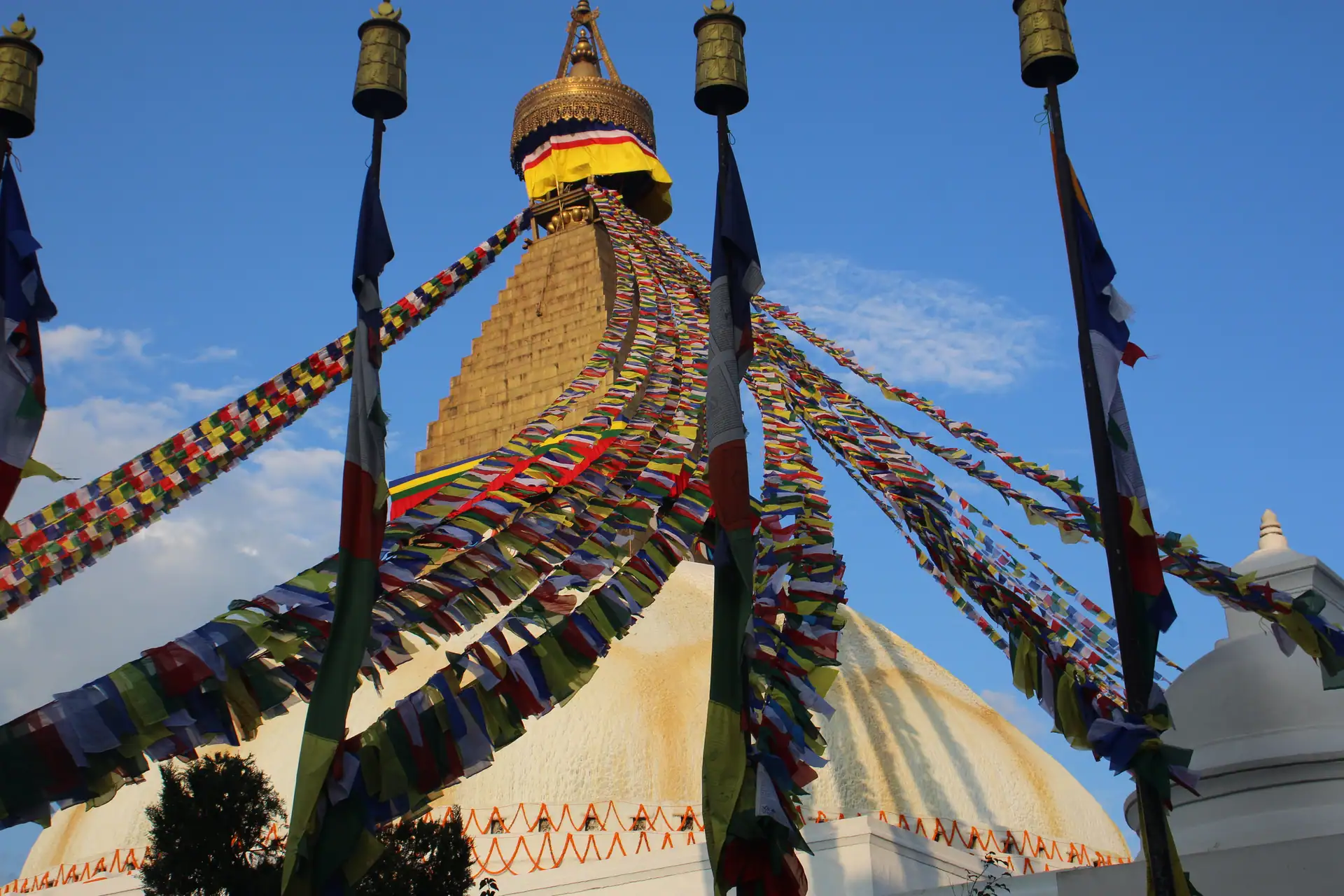
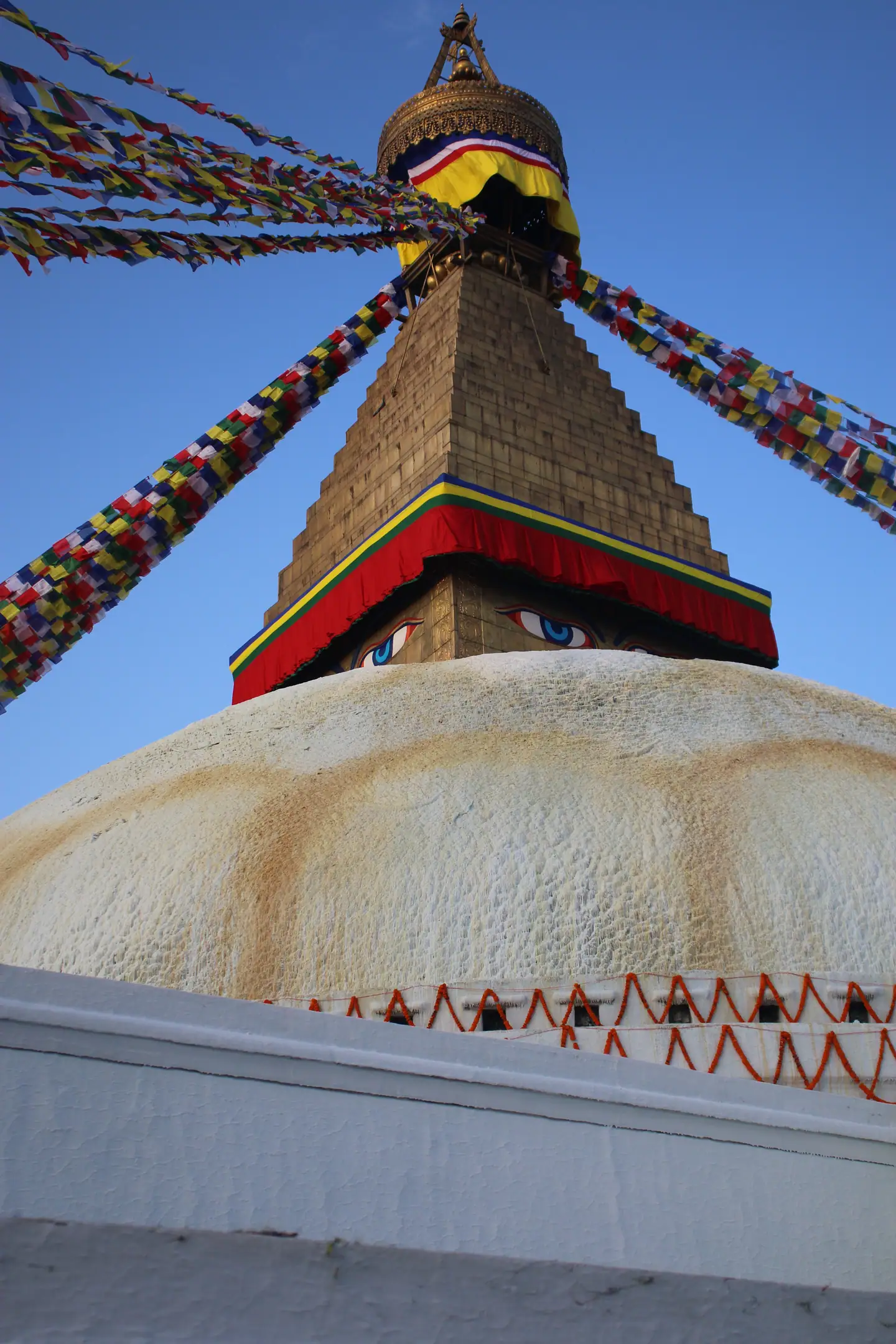
Buddha Jayanti, the full moon of April or May, marks the birth, enlightenment and death of the Buddha and is observed at Lumbini, Boudhanath and Swayambhunath alike.
How should I behave at a monastery or a stupa?
Walk clockwise. Around a stupa, around a mani wall, around a monastery courtyard, keeping it on your right.
Turn prayer wheels with the right hand, and turn them clockwise. A wheel spun the wrong way is politely reset by whoever is behind you.
Shoes come off at the door of a shrine room. Do not point the soles of your feet at an altar or at a monk, and do not sit above a statue or a text.
Ask before photographing a monk, and never photograph during a ceremony unless you are told it is fine.
How high are the Buddhist monastery routes?
Tengboche sits at 3,867 metres and is reached on foot over several days from Lukla. There is no way to shorten the walk safely; the acclimatisation is the point of the schedule, not padding in it.
Boudhanath and Swayambhunath are in Kathmandu at valley level and need no preparation at all. They are the easiest introduction to the practice before anything higher.
Where do the Hindu and Buddhist paths meet?
Muktinath is a Vishnu temple to Hindus and Chumig Gyatsa, the hundred waters, to Tibetan Buddhists. Nyingma tradition holds that Guru Rinpoche, also called Padmasambhava, meditated there in the 8th century on his way to Tibet.
The Halesi caves, where by Hindu tradition Shiva hid from the demon Bhasmasura, are Maratika to Buddhists, where Guru Rinpoche and his consort Mandarava are said to have attained the practice of long life. Both traditions still use them.