
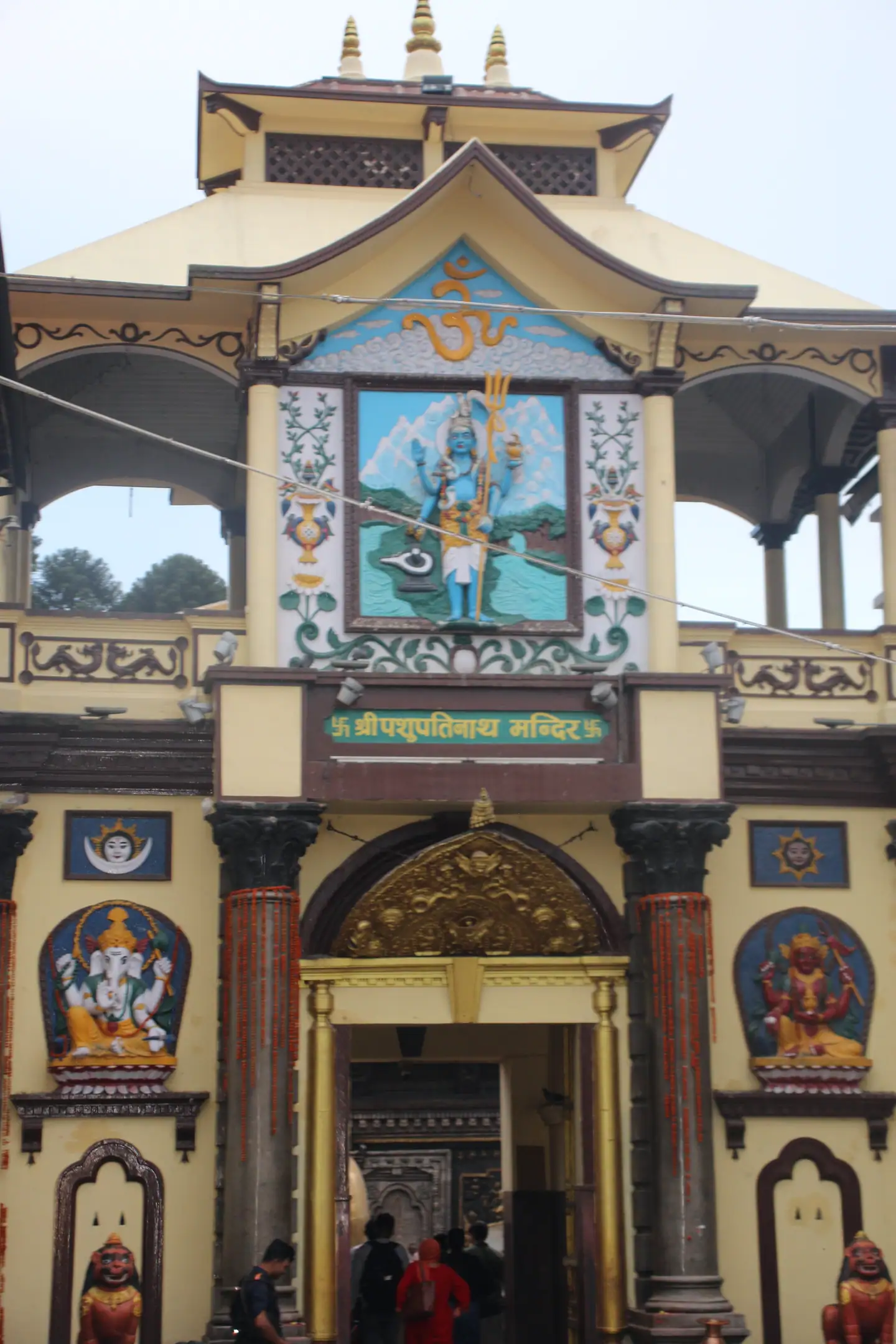
The main temple is for Hindus only
Only Hindus may enter the main temple at Pashupatinath in Kathmandu. Visitors of every faith may enter the Pashupatinath complex and walk freely around the main temple: the ghats on the Bagmati, the gardens, the smaller shrines and the terraces on the eastern bank.
No document test for who counts as Hindu is published, so nationality alone does not settle the question.
Where to stand: the eastern bank
The terraces on the eastern bank, across the Bagmati from the main temple, are where non-Hindu visitors see the temple and watch the aarti. Beside them stands the Pandhra Shivalaya, a row of fifteen small Shiva temples.
First-time visitors often miss the Shleshmantak and Mrigasthali forest, a sacred grove, the 7th-century Vishnu image in the Ram Temple, and the 7th-century Durga image at Bankali.
When to go
The early-morning ritual period and the evening aarti are the best times to visit. As of October 2026 the evening aarti runs from 6:00 to 7:30 pm, and visitors of all faiths watch it from the eastern bank.
On Maha Shivaratri, in February or March, the temple stays open through the night. Non-Hindus watch the festival from the eastern bank, as on every other day.
Entry fee and getting there
As of 24 September 2026, foreign visitors pay NPR 1,000, about USD 6.50, per day per entry. Nepali and Indian nationals enter free. You need no permit, and the published rules do not require a guide.
Pashupatinath is 15 to 20 minutes by taxi from Thamel, or a bus ride on route 11, 22 or 30 to Gaushala and a five-minute walk.
Rules on the temple grounds
Shorts and sleeveless tops are not permitted on the temple grounds, so wear modest clothing. Take off your shoes before entering a shrine, keep leather items out of the temple area, and do not touch sacred objects unless invited.
Photograph the ghats and public spaces respectfully. Photography is prohibited inside the main temple and during religious ceremonies, and you should never photograph cremations or mourners. Where signs or guards set a stricter rule, follow it.
Aryaghat and the other cremation ghats lie below the main temple. Keep your voice low there, give funerals space, and do not block processions, priests or families.
More in the encyclopedia: Pashupatinath Temple.
The journeys this is about
Kathmandu Mahadev Darshan
The Kathmandu Mahadev Darshan is a 5-day Shiva pilgrimage in the Kathmandu Valley by private vehicle, visiting Pashupatinath, Bhaleshwor Mahadev at Chandragiri by cable car, Doleshwor Mahadev, the 143-foot Kailashnath Mahadev statue at Sanga, Gokarneshwar Mahadev and Santaneshwar Mahadev. Sama Yatra prices it from USD 1,430 per person for a group of 21 or more.
See the itineraryMaha Shivaratri Festival Tour
The Maha Shivaratri Festival Tour is a 7-day pilgrimage timed so that its sixth day falls on Maha Shivaratri at Pashupatinath in Kathmandu, the largest gathering of the year at the temple, with Muktinath and Galeshwor Mahadev visited beforehand. It is priced at USD 1,210 per person for any group of two or more.
See the itinerary